


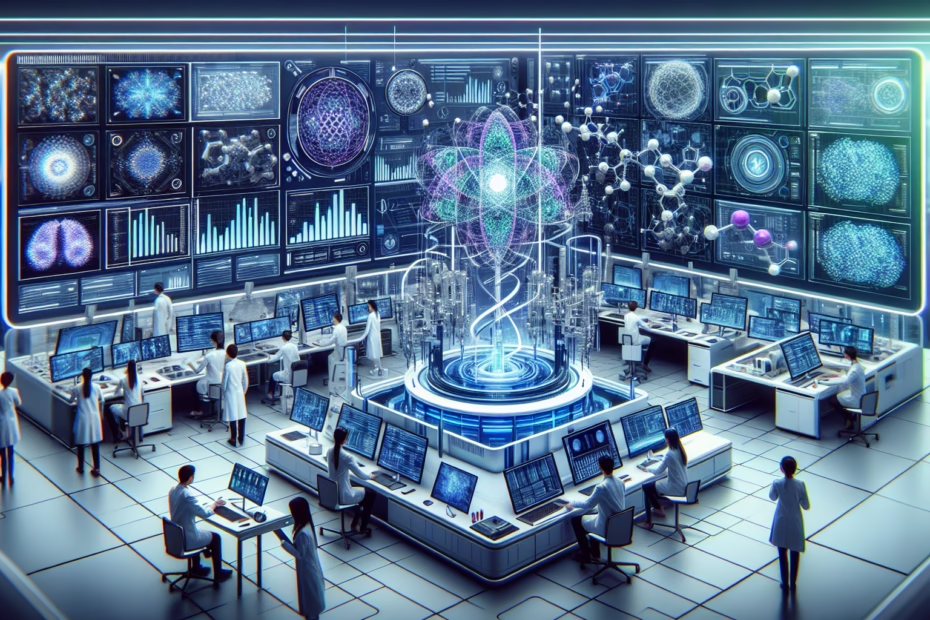
Artificial Intelligence in Scientific Research: When Agents Become Team Members
The growing integration of Artificial Intelligence (AI) agents in scientific research is revolutionizing the way we conduct experiments and make discoveries. From climate modeling to molecular design and the creation of new materials, these technologies are becoming essential members of laboratory teams. Companies like Microsoft, OpenAI, and DeepMind already have dedicated teams exploring the potential of AI in these areas, and there are predictions that by 2026, AI will begin to co-author scientific papers in a substantial way.
The AI Revolution in Scientific Research
The incorporation of AI tech into scientific research is not just a passing trend; it is a profound transformation that alters the very nature of scientific work. Historically, scientific advancement relied heavily on human intuition and empirical methods. Today, with the help of AI, we can process vast amounts of information at unimaginable speeds, allowing for quicker and more accurate insights.
Climate Modeling: Predicting the Future with Precision
One field where AI has shown significant impact is climate modeling. The global climate is a complex system with numerous interdependent variables. Traditionally, climate models required extensive calculations that took weeks or even months to complete. With the use of advanced AI algorithms, scientists can now simulate future climate scenarios with greater accuracy and in less time.
For example, convolutional neural networks (a type of deep learning algorithm) are used to analyze historical climate patterns and predict future changes. This besides .* also improves the accuracy of forecasts by identifying correlations that might go unnoticed by traditional methods.
Molecular Design: Accelerating Pharmaceutical Discoveries
In the pharmaceutical field, molecular design is a critical process for developing new drugs. Traditionally, this was a time-consuming process involving large-scale trial and error. Today, with the help of artificial intelligence, researchers can predict which molecular combinations are most likely to succeed even before they are synthesized in the lab.
Generative adversarial networks (GANs), for instance, are used to create new molecular structures virtually. These models simulate millions of possible chemical interactions within hours. This besides .* also lowers the costs associated with research and development.
Creating New Materials: Innovation Through Computation
The creation of new materials has always been a resource-intensive area due to the complexity of the processes involved. With AI, scientists can now rapidly explore vast material spaces and identify promising candidates for specific applications.
A notable example is the use of reinforcement learning (a type of machine learning where agents learn by taking actions in an environment to maximize some notion of cumulative reward) to develop stronger and lighter metal alloys. This approach allows testing thousands of possible combinations without the immediate physical need for traditional laboratory tests.
Pioneering Companies Integrating AI into Science
Leading technology companies are at the forefront of this scientific revolution driven by intelligent systems. Microsoft, OpenAI, and DeepMind are just a few organizations that have dedicated entire teams to explore how intelligent agents can transform scientific research.
Microsoft: Empowering Scientific Discoveries
Microsoft has heavily invested in using AI to accelerate scientific discoveries through its AI for Earth project (https://www.microsoft.com/en-us/ai/ai-for-earth). This project aims to apply advanced computational intelligence techniques to solve critical environmental challenges using massive data collected globally.
also, its Azure ML platform offers powerful tools that allow researchers to build custom models tailored to their specific needs without requiring deep knowledge in computer science.
OpenAI: Exploring Frontiers of Knowledge
OpenAI is another pioneering organization whose main focus is ensuring that the benefits of AI are widely distributed across humanity while exploring new technological frontiers (https://www.openai.com/research/).
Its projects range from autonomous systems capable of performing complex tasks to virtual assistants specifically designed to help scientists conduct more efficient research by leveraging superior analytical capabilities available through these emerging intelligent platforms in today’s globalized market!
DeepMind: Transforming Scientific Theories into Practical Reality
DeepMind has been innovative in applying deep learning directly to challenging scientific problems such as protein folding—a known biological challenge key for understanding the three-dimensional structure of proteins determining cellular functionality within living organisms!
With AlphaFold2 (https://www.deepmind.com/research/case-studies/alphafold), they have achieved significant advancements in this area previously considered nearly impossible to fully solve due to the intrinsic complexity involved in these detailed molecular interactions!
The Future: Co-authorship Between Humans & Machines?
Based on current trends observed in the aforementioned industries along with predictions made by renowned experts worldwide about the continuous evolution of these emerging disruptive technologies, it is expected that by 2026 we will see a significant increase in the number of academic papers published co-authored between humans and machines!
This new era of symbiotic collaboration promises besides .* also redefine traditional roles played by researchers within the context of modern global academia where we currently live!
Ethical Challenges & Social Implications
While there is much excitement about the transformative potential of these emerging technologies, we must remember there are important ethical challenges that need to be adequately addressed to ensure responsible and safe implementation of these innovative solutions!
Among the issues raised are concerns related to privacy regarding personal information used for training these models as well as potential algorithmic biases resulting from inadequate representation during the initial development phase of these intelligent automated systems!
so, as we continue advancing towards an increasingly digitally interconnected future, we need to ensure a careful balance between innovation and social progress alongside ethical responsibility and long-term environmental sustainability aimed at promoting common welfare for all contemporary global society!
Additional Resources for Continuous Learning:
For those interested in delving deeper into this fascinating world of intelligent systems applied to scientific research, we recommend reading the following book available in Portuguese:
- “Artificial Intelligence: A Modern Approach” by Stuart Russell and Peter Norvig – Considered a definitive reference in the field covering everything from theoretical foundations to diverse practical applications including real-world case study examples!
also, we suggest visiting internationally recognized websites constantly updated with relevant content on related topics such as:
- AI for Earth by Microsoft Microsoft AI for Earth
- OpenAI Research OpenAI Research
- DeepMind AlphaFold DeepMind AlphaFold
These resources will provide a solid foundation for an in-depth understanding regarding the growing role played by Artificial Intelligence within contemporary academic-scientific contexts so enabling active participation in pertinent debates surrounding our advanced modern technological society’s future!