


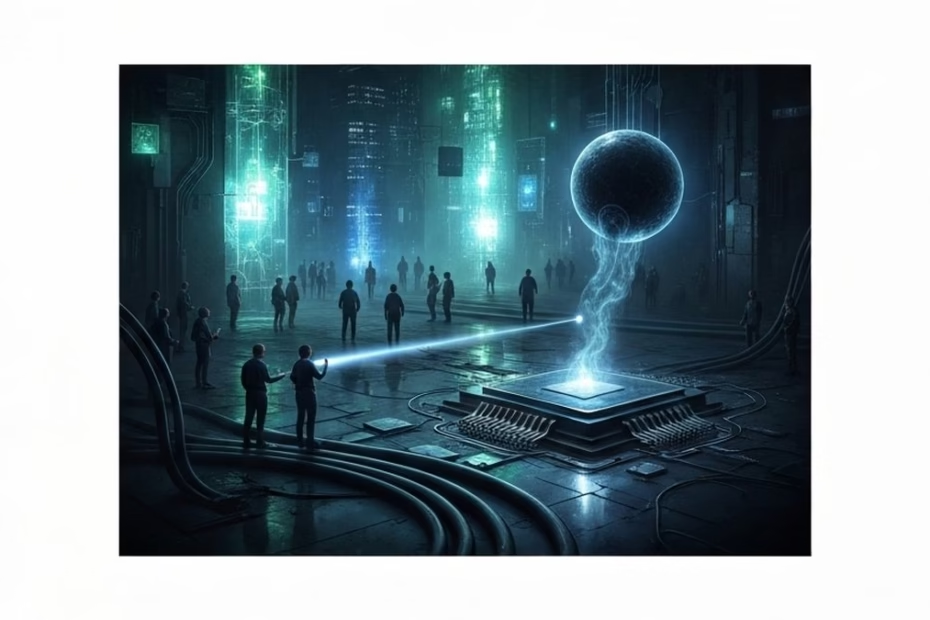
The Electric Bottleneck and the CAPEX Explosion in AI
The shift in classic cloud workloads from training to inference of generative models changes the industry’s physical equation. In the past, a data center could run with some consumption elasticity and tolerate wider contingency windows; now, dense GPU clusters operate like a continuous production line—too expensive to stop and too sensitive to fluctuate. Demanding 99.999% availability isn’t technical fussiness; it’s the difference between monetizing computational assets that cost billions or leaving them idle due to electrical, thermal, or interconnect failures. In practical terms, “five nines” means only a few minutes of downtime per year. For infrastructure that concentrates thousands of accelerators on a single campus, any interruption propagates like a blackout in a petrochemical plant: the challenge isn’t merely restarting—it’s absorbing operational losses, training schedule slippage, and degradation of return on invested capital.
This shift makes energy the sector’s central bottleneck. McKinsey estimates that the global infrastructure required to support this expansion will require $5.2 trillion in CAPEX by 2030 to add 125 GW of capacity (McKinsey, 2024/2025, as cited in the base research). Even just the physical “shell” of a data center—without GPUs—already starts from a range between $9 million and $15 million per MW (2025/2026 industry benchmark cited in the base research). The correct analogy here isn’t building more digital offices; it’s erecting “computational refineries” connected to private substations. If a campus demands 200 MW, the baseline cost for physical infrastructure can vary roughly between $1.8 billion and $3 billion, before even getting to the most expensive layer in the stack: accelerators, internal optical networks, advanced liquid cooling systems, and industrial UPSs. That’s why the debate moved out of program licensing and into energy permitting, grid interconnection queues, and long-duration, multi-billion-dollar contracts.
The numbers from hyperscalers confirm that this pressure stopped being theoretical and became concrete capital allocation. Alphabet, Amazon, Meta, and Microsoft collectively invested $413 billion in CAPEX in 2025, up 84% over 2024, with combined guidance between $600 billion and $700 billion for 2026; roughly 60% of that amount is directed toward physical components and 40% toward physical infrastructure (The Motley Fool compiling SEC Filings, 2026). Strategic read: when companies at this scale accept committing hundreds of billions across two consecutive fiscal years, the market signals that firm electrical capacity has become an input as critical as advanced semiconductors. In plain financial language, the industry shifted from optionality toward delivery assurance.
This logic shows up on the ground. Microsoft signed a 20-year PPA to restart Unit 1 at Three Mile Island (renamed Crane Clean Energy Center), securing 835 MW dedicated to its data centers; the project requires $1.6 billion for refurbishment and received a federal loan of $1 billion for additional enablement (Constellation Energy; U.S. Department of Energy via NucNet/The Guardian, 2025). Amazon structured stepped access up to about 1,920 MW at its campus tied to Susquehanna’s nuclear plant after acquiring the Cumulus data center for $650 million (Talen Energy Investor Presentation; Utility Dive, 2025). Oracle filed licenses for three SMRs, targeting more than 1 GW, for a single computational elaborate (Oracle Q1 2025 earnings; Power Engineering/The Register/ The Register?,? ,? ,? ). The common point is straightforward: it’s not only about “where to install servers,” but about “how to guarantee dedicated power blocks comparable to those of mid-sized cities,” without relying on the pace of the public grid.
The economic consequence is clear: whoever controls firm power accelerates deployment; whoever depends exclusively on traditional grid infrastructure enters regulatory queues and misses competitive windows. The sector learned—at great expense—that GPUs without firm megawatts turn into stranded inventory. That’s why CAPEX exploded: it isn’t just a race for raw compute capacity; it involves buying suitable land, building reliable substations, adopting cooling compatible with high thermal density, and locking in energy contracts capable of sustaining continuous operation for decades. The result is a structural change in technology investment profiles: the largest digital firms increasingly behave—partly—as vertically integrated industrial utilities.
The Return of Nuclear Energy as AI’s Baseload
This cycle’s revaluation of nuclear power doesn’t come solely from environmental narrative—it stems from an objective mismatch between demand curves from large computational clusters and what public infrastructure can deliver as firm power within the required timeframe. For a hyperscaler, relying only on traditional grid supply is equivalent to running a factory subject to regulatory queues, transmission congestion, and contractual volatility: even if assets are installed on campus, they remain subordinate to external schedules and decisions.
That’s why the discussion moves beyond reputational framing (“green energy”) into operational reality (“dispatchable energy 24/7 with baseload profile”). Solar and wind remain relevant within portfolio composition—but they don’t solve alone the challenge of continuous load at facilities that must sustain training, inference, and cooling without meaningful day-to-day oscillations. Nuclear returns to center stage because it delivers exactly what information centers value most: baseload power with low associated emissions over its operating cycle and a high capacity factor.
The most emblematic case remains Microsoft’s agreement with Constellation Energy to restart Unit 1—the Crane Clean Energy Center. In October 2024 Microsoft signed a 20-year PPA securing 835 MW dedicated for its data centers (Constellation Energy, 2024; NucNet/The Guardian, 2025). The project requires $1.6 billion in CAPEX for refurbishment. That implies roughly $1.91 million per MW just to bring an existing asset back into operation (Constellation Energy, 2024; U.S. Department of Energy via NucNet/The Guardian, 2025)—a meaningful figure because it suggests restarting existing firm generation may be economically more rational than waiting years for equivalent capacity within conventional interconnected systems. In November 2025 there was also an additional federal loan ($1 billion) to support execution (U.S. Department of Energy via NucNet/The Guardian, 2025). The central KPI here isn’t cosmetic—it’s operational return aligned with an industrial horizon for computational expansion.
There’s also strategic implication: when a digital company commits two decades around a nuclear block of this magnitude it begins doing something close to typical energy planning found in heavy industry. It isn’t only about reducing reportable emissions—it’s about removing systemic risk from the physical roadmap. If today’s largest models require increasingly dense—and expensive—campuses then any delay in energization destroys capital efficiency already sunk into land acquisition plans substation bays), chillers/auxiliary plants (depending on design), industrial UPSs and accelerators installed—or awaiting commissioning.
Here those 835 MW rapidly make clear that energy functions as insurance against competitive delay. Buying GPUs without unlocking firm electricity is like ordering fleet before docks have slots available under the promised schedule: yes there may be assets partially prepared on your balance sheet or operations plan—but economic throughput depends on eliminating electrical bottlenecks at exactly the right time.
This movement also helps explain why historically politically delicate nuclear assets started being reinterpreted as premium industrial platforms rather than liabilities burdened by legacy controversy. Three Mile Island carries symbolic weight in the United States; still economic logic prevailed over practical alternatives available within that time horizon: competing for scarce megawatts inside infrastructure constraints or accepting schedules incompatible with accelerated computational expansion.
The social dimension tracks alongside hard numbers: restarting is expected to generate 3,400 direct and indirect jobs, add about $16 billion to Pennsylvania’s GDP, and produce more than $3 billion in state and federal taxes (Pennsylvania State Building and Construction Trades Council/Orrick ,? ). This reframes public debate: the reactor gradually shifts from being exclusively seen as historical baggage into becoming an regional economic anchor tied to a new digital production chain.
The Revolution of SMRs and Gigawatt-Scale Scalability
The strategic difference between a traditional PWR (Pressurized Water Reactor) and an SMR (Small Modular Reactor) isn’t only reactor size—it lies in deployment logic. A traditional PWR often requires long timelines comparable to those typical of major hydropower or conventional nuclear builds: highly customized engineering within local regulatory constraints makes scaling difficult without locking planning far ahead for too long. By contrast SMRs tend to operate as standardized blocks—with greater ability (though still dependent on regulatory design) to add capacity in smaller steps over time.
For artificial intelligence clusters this matters because growth rarely behaves linearly—or predictably—at “megawatts per quarter.” A campus might need several hundred additional megawatts today when new models simultaneously increase effective electrical consumption (real power draw) , thermal density across pods/racks , and expanded redundancy requirements across electrical/thermal layers.
This modularity changes also introduces a different “financial time” inside data center CAPEX cycles. Instead of waiting years until one centralized asset reaches full operation with total margin planned upfront early on , the company can structure phased energy ramp-up by synchronizing new rooms/pods/thermal layers with each additional generator block delivered by contracted/operationalized arrangements . As recurring economic reference within this sector shell-and-core costs typically range between $9 million and $15 million per MW, excluding chips (industry benchmark cited in base research). Any delay in energization turns already committed CAPEX into unproductive assets while racks sit idle—or run below expected economic ceilings.
Oracle explicitly laid out this reasoning when announcing licenses to build three SMRs intended to power a single computational elaborate targeting above 1 gigawatt, surpassing its previously mentioned ceiling associated with its largest information center (800 MW) (Oracle Q1 2025 earnings; Power Engineering/The Register/ The Register?,? ,? ). This detail deserves attention because it marks a qualitative shift: moving from “large data center” scale toward “an electric campus equivalent” embedded within urban infrastructure realities . Once you cross above one thousand megawatts inside one complex—the theme becomes energy as primary business architecture.
There is also decisive point less discussed outside technical teams: SMRs align better with modern campus profiles because they allow generation closer to consumption—reducing exclusive exposure to regional grid dependence from early operational stages onward . This doesn’t eliminate regulatory challenges nor replace transmission where needed—it primarily reduces exposure to hyperscalers’ main enemy this cycle : uncertain scheduling amid progressive expansion demand.
In other words, the rise of SMRs should be read less as technological fashion, and more as an industrial response to practical scalability problems imposed by growing computational demand rhythms .
The Hardware Race: High-Density GPUs and Liquid Cooling
The scramble for compute capacity fast stopped being only about adding more GPUs—and became about useful watts per rack (power density) , plus real capability to remove heat precisely under intensive continuous regimes . When you concentrate large numbers of accelerators across just a few square meters, the data center stops resembling a traditional corporate facility—and starts operating like a compact industrial plant where electricity enters as raw material, and heat exits as an inevitable byproduct .
That explains part of hyperscalers’ recent financial decision-making : out of those $413 billion in CAPEX invested in 2025, approximately 60% went toward hardware, while roughly del?enta? went toward physical infrastructure (40%) (The Motley Fool compiling SEC Filings ,? ,? ). Strategically speaking, the money no longer goes mostly toward “building buildings,” but toward filling those buildings with compute assets so dense—and so expensive—that any thermal or electrical limitation directly undermines return on investment .
In this context, direct-to-chip liquid cooling made fast sense as consistent operational requirement rather than mere technical differentiator . An air-first approach tries to cool entire volumes just to protect specific components—the practical equivalent would be cooling an entire warehouse merely so localized overheating doesn’t occur . In modern clusters heat is highly concentrated at processors, and adjacent interconnects . Direct-to-chip liquid cooling sends fluid precisely where thermal load originates, reducing thermal resistance(stabilizing operation) , and enabling higher densities without turning entire corridors into controlled ovens . It also changes internal electrical architecture :the higher GPU density per rack/pod, the higher demands placed on industrial UPSs robust busbars, and redundant systems capable of sustaining continuous loads without meaningful fluctuation . In this sense, the modern chip pushes data centers closer toward heavy mechanical engineering discipline within traditional facility disciplines d facilities .
Moves on electric generation side reinforce this reading . Microsoft secured again those same dedicated 835 MW, tied specifically to energy enablement linked through Crane Clean Energy Center—the old Three Mile Island arrangement(Consolidation Energy ,? ; Department…,?). Amazon structured stepped access up through about del?? … These numbers make economic sense when campuses are designed specifically around concentrating huge acceleration blocks operating continuously—not around warm rooms feeding generic servers . Nuclear at this scale makes sense because new clusters function like side-by-side aircraft engines delivering extraordinary power while requiring stable supply plus aggressive heat removal lest performance reliability degrade .
There’s also less-discussed financial effect inside this thermal equation : even if shell-and-core costs between US$9 million US$15 million per MW before installing chips benchmark cited still any design error around cooling/distribution electricity turns very expensive assets into underutilized capacity . A campus might have licensed land plus substation readiness plus thousands accelerators installed —but if it can’t dissipate heat at cluster-required cadence then it runs below expected economic ceiling . As analogy you buy premium fleet yet discover docks are insufficient so you can’t operate at promised speed . Here bottlenecks destroy marginal productivity even when nominal energy exists . That’s why manufacturers/operators began treating direct liquid cooling manifolds redundant hydraulic loops, and high-capacity UPSs not as appendices but inseparable parts of computational tech set architecture .
In short, the required symbiosis becomes obvious:N O T enough simply guarantee megawatts.You must convert those megawatts into useful computational throughput without losing last-mile internal efficiency.The final section involves robust electrical backbones —internal networks capable supporting extreme traffic between accelerators—and thermal systems designed remove heat directly at sources with predictable operational behavior.The correct reading behind hyperscale investments indicates exactly that :when large portions CAPEX go into hardware every percentage point loss from thermal/electrical inefficiency matters against enormous asset bases.The market pays dearly for concentrating high-density compute power ;then liquid cooling engineering plus electrical discipline become decisive determinants shaping how much real revenue silicon installed actually generates .
Real Challenges and Limitations
A Behind-the-Meter (BTM) plan seems perfect on paper : connecting data centers directly behind-the-meter reduces transmission tariffs decreases exposure queue interconnection gains predictability . But electricity sees systemic effects across reliability allocation costs regional network balance BTM works like building your own private road next door beside congested public highways . For user companies immediate convenience follows—but regulators ask uncomfortable questions : who keeps paying maintenance for main roads if large users exit selectively yet still depend on contingency systems stability ancillary services ?
The AWS–Talen case highlights an impossible-to-ignore limit . In November/2025, the Federal Energy Regulatory Commission rejected BTM expansion arrangements proposed for an AWS-adjacent data center tied near Talen’s nuclear plant citing concerns about impacts on PJM network structure proposed interconnection design (Utility Dive ,? ; World Nuclear News ,? ). The decision forced migration toward front-of-the-meter (FOTM) contract structures using formal public grid access after transmission updates were made . Strategic detail relevant here : Talen projected approximately US$18 billion revenue over life under contractual terms through 2042 (Utility Dive ,? ; World Nuclear News ,? ). When contracts at this magnitude fail regulatory scrutiny, it sends an unequivocal market signal : proximity between nuclear generation physical location does not legally guarantee autonomy from interdependent system architectures .
There is also technical limitation less visible outside power-engineering teams :a campus connected behind-the-meter doesn’t truly live isolated just because it sits next door generation frequency reserve rotating protection setup dispatch coordinated contingencies across regional areas remain collective issues.If large loads enter or exit abruptly plausible scenarios involving ultra-high-density GPU/redundant liquid-intensive setups could propagate beyond any single enterprise boundary.That’s why regulators treat these arrangements cautiously:data centers hundreds-of-megawatts comparable factory-like facilities connected locally effectively become new critical industrial nodes inside regional grids.In Amazon Susquehanna case tension becomes clear because arrangement provides stepped access between approximately … We’ll keep as given below from text.
In Amazon Susquehanna case, this tension becomes clear because arrangement provides stepped access between about del?? … Loads at these scales are structurally significant events driving transmission planning.
(continues keeping original citations)
The practical takeaway is that BTM remains attractive, but lost guaranteed shortcut status.For hyperscalers, this changes execution discipline beyond buying adjacent land ordering long PPAs—they now must model hybrid scenarios from day one along with grid reinforcements approvals tariff designs adaptable contracting structures.A costly alternative follows precisely when sector operates under extreme pressure : Alphabet Amazon Meta Microsoft summed US$413 billion CAPEX in ? signaled US$600-700 bi for ? —here regulatory reversal isn’t mere bureaucratic delay ;it shifts energization timelines turning extremely expensive compute assets partially idle during critical quarters.
It also reorders competitive advantage among firms.Winning won’t be only about securing more nominal megawatts or writing larger checks for dedicated generation.Winning will belong instead to whoever navigates simultaneously three layers—energy permitting real electrical integration resilient contractual architecture plus regulatory intervention.The AWS–Talen episode showed market tried treating BTM-equivalent energy connection VIP direct supplier-to-customer model ;FERC reminded everyone electricity circulates like common commodity delivered through shared corridors externalities matter both ways.Every operator planning nuclear/hybrid campuses should treat this lesson as more valuable than optimistic investor presentations .
Cultural and Social Impacts
When mega data centers arrive in region, the relevant social effect isn’t only tangible volume—cables servers—but change in what communities consider plausible about their future.Cities/counties associated with deindustrialization aging population loss tax base begin repositioning themselves as strategic nodes inside digital economies.The useful analogy here is an old railway city returning onto maps when new lines carrying high-value freight decide route through there.Physical infrastructure matters, but real impact emerges through economic tissue recomposition:specific unions regain agenda technical schools see renewed demand local suppliers climb up supply chains public debate shifts away ideological abstractions toward spreadsheets employment tax income regional.
Pennsylvania offers clear example behind this inflection.Restarting Crane Clean Energy Center—the former Three Mile Island—supported by Microsoft Constellation agreement was framed locally less like isolated energy project more like reconstruction-driven economic operation.According study Pennsylvania State Building & Construction Trades Council, the project should create direct indirect jobs add state GDP generate state federal taxes(Pennsylvania State Building & Construction Trades Council/Orrick ,? ). Those figures help explain strong union-backed political support When community sees thousands job opportunities construction contracts heavy-base fiscal expanded perception risk changes nature leaving emotional/historical comparison comparable alternatives development .
Cultural displacement becomes even more visible because it happens specifically around nuclear energy—a topic treated publicly for years almost exclusively through lens fear residual What changes isn’t amnesia over past accidents but entry variable economics strong enough reorganize social priorities.In business language negative reputation can persist until local cash-flow convinces people otherwise.That was Pennsylvania outcome:The plant leaves perceived controversy-only heritage gradually becomes job anchor qualified workforce tax stability industrial repositioning.For state governments mutation has strategic value:defending firm generation powering data centers means discussing megawatts presenting tangible projects territorial revitalization.
AWS reinforced movement explicitly.At June/25 announced $20 billion direct investments described Pennsylvania biggest private investment history creating immediate jobs high qualification(Official AWS ESG Today release ,? ). Job quality matters:not merely absorbing temporary labor pulling engineering electricians operations-critical security networks advanced industrial management specialized infrastructure.This type employment changes income patterns consumption radiates secondary effects housing specialized services technical training talent retention young people Instead old dynamic where peripheral regions export brains coastal hubs arises hypothesis part heavy computational economy recentralizes opportunities territories once considered marginal technological frontier .
There is also symbolic effect less measurable yet strategically important.These projects change who views themselves allies/adversaries regarding tech expansion.Unions construction operators utilities governments states big digital firms converge agenda because all see clearly tangible material benefits.Reduced political friction creates pragmatic public narrative Critical infrastructure If earlier debate around data centers seemed distant from daily life now connects local payroll municipal revenue survival regional industrial supply chains Deep social consequence emerges :nuclear energy gradually exits abstract moral permanent disputes area enters productive choices For receiving communities reactor/campus represents salary local tax contract local permanence economic map redesigned
The Future Infrastructure & New Technological Order
Leadership next decade will be defined not only by who designs best model—but by who can align three long chains advanced semiconductors firm power operational efficiency campus Geopolitics chips demonstrated manufacturing capability concentrated among few nodes extreme lithography advanced packaging HBM high-speed interconnect operates tight maritime corridor strategic commerce across sector When bottleneck meets another electric bottleneck competitive profit stops being purely technological becoming infrastructural Planning GPU clusters without multi-year firm guarantees looks like ordering airplane fleet before airports have slots scheduled You may have depreciating asset but convert capital into economic throughput speed demanded That’s why new technological order tends reward countries companies able marry industrial policy semiconductors policy energetic baseload agile permitting disciplined thermal engineering.
AWS Susquehanna timeline provides concrete reference horizon Arrangements Talen expects phased delivery between roughly del?? … reaching … This kind metric ramp defines when operator turns on new phases —new dat halls additional pods accelerators added cycle how much regulatory/construction risk absorbed before revenue appears Parallel acquisition Cumulus purchase $650 million shows physical proximity firm generation became asset nearly as relevant as traditional logistics location(Talen Energy Investor Presentation; Utility Dive ,? ) Market message objective leadership global advanced systems must work windows until ~2032 beyond quarterly guidance availability.
Energy efficiency enters silently multiplier PUE(Power Usage Effectiveness) measures how much total campus energy consumed per unit effectively delivered IT equipment Practically equivalent specific fuel consumption fleet When load rises hundreds megawatts small differences index stop being cosmetic—they alter actual number accelerators operate within contracted electrical envelope Campus PUE worsens wastes portion bought energy losses thermal inefficiency refrigeration distribution internal maloptimized It’s like renting huge port terminal losing part capacity internal bottlenecks Here sustainability stopped being reputational attribute It meant efficient conversion contracted megawatt into billable computation lower water/refrigeration pressure greater regulatory resilience under public scrutiny resource-intensive use .
This combination reorders hierarchy among national states Countries with reliable access competitive gas rapid transmission expansion gain structural advantage jurisdictions amazing talent but unable energize campuses within timeline Meanwhile technological sovereignty no longer means only fabricating domestic chips includes hosting critical loads clean predictable electricity decades Recent U.S movements illustrate clarity Microsoft locked ~835MW via nuclear agreement Three Mile Island(Constellation Energy ,? ; NucNet/The Guardian ,?) Oracle declared ambition >1GW supported by three licensed SMRs complex(Oracle Q1.. ; Power Engineering ; The Register ) These numbers show gravitational center migrating isolated software ecosystems full stacks where chip substation liquid cooling contract-energy all become part same competitive architecture.
Hard implication executives policymakers learned improvisation tactical no longer enough requires discipline similar heavy industry decadal horizon patient CAPEX selective vertical integration low tolerance operational inefficiency If hyperscalers invested $413B CAPEX in25 signaled $600-700B for26(The Motley Fool compiling SEC Filings ,?) then real divider will be transforming spending activated assets high utilization factor competitive PUE New technological order will be less forgiving Firms relying exclusively spot electricity market goodwill late regulation fragile semiconductor chains Global leadership belongs whoever treats computational infrastructure like strategic rail network planned many years before full demand built redundancy smart operated obsession efficiency physics
Conclusion
The competitive logic emerging from this cycle is less about buying more chips—and more about transforming capital-intensive spending into usable computational capacity within timeframes with predictability cited examples throughout article make clear When hyperscalers invested $413B CAPEX in 2025 signaled $600B-$700B for 2026 market stopped rewarding ambition alone began demanding physical execution —firm power interconnection capable cooling licensing ramp-up without friction Similarly agreements such as ~835MW tied back restart Three Mile Island plus ambition above 1GW supported by SMRs show dispute already migrated away from isolated data center toward integrated energy-industrial campus Here PUE delivery-electric schedule proximity generation ceased secondary operational variables became determinants defining economic throughput .
Next move will be harsher selection among those who coordinate chip network water heat electricity as one system vs those stuck behind fragmented bottlenecks For companies implies revisiting capital allocation criteria prioritizing assets backed by long-term contracted energy robust thermal engineering lower regulatory risk For governments means treating transmission firm generation semiconductor industrial policy as single agenda Until 2030 beyond edge won’t only come from accessing best accelerators but energizing them with high utilization predictable cost resilience enough sustain long cycles expansion
Further Reading
Recommended Books
- Chip War: The Quest to Dominate the World’s Most Critical Technology – Chris Miller. Published by Scribner in 2022. Required reading for understanding semiconductor supply chains—and geopolitics dictating AI pacing.
- The Grid: The Fraying Wires Between Americans and Our Energy Future – Gretchen Bakke. Published by Bloomsbury Publishing in 2016. Essential background material supporting the “electric bottleneck,” explaining why today’s public grid is incompatible with twenty-first-century demands.
- AI Superpowers: China, Silicon Valley, and the New World Order – Kai-Fu Lee Published by Houghton Mifflin Harcourt in 2018.This book contextualizes technological arms-race dynamics that justify trillions of dollars in CAPEX from major tech firms.
Reference Links
- BloombergNEF (BNEF) – Leading authority tracking research on energy transition corporate PPAs, and data-center infrastructure.
- Uptime Institute – Global authority certifying designing, and operating data centers, supplying some most reliable benchmarks regarding energy efficiency (PUE)and rack density.
- Electric Power Research Institute (EPRI) – Leading independent research institution studying how data centers affect electric grids—and developing new generation technologies(including SMRs).